Related Articles


.png)
.png)





Traditional marketing doesn't work in crypto. Most Web3 founders learn this the expensive way.
Many blockchain projects struggle with marketing because they apply traditional strategies to a fundamentally different space. Standard marketing approaches that work for software companies or consumer brands often fail in crypto. The issue isn't execution—it's understanding that crypto marketing requires a completely different framework.
Crypto marketing operates on fundamentally different principles. The audience is technically sophisticated and deeply skeptical of empty promises. Traditional conversion funnels don't apply when your "customers" are actually stakeholders and governance participants. And good luck running Google Ads for your token launch when most crypto advertising gets rejected before it even goes live.
This is why specialized crypto marketing agencies exist. Successful cryptocurrency marketing requires a completely different playbook—one that prioritizes community engagement over ad spend, education over promotion, and long-term ecosystem building over short-term metrics. The best agencies understand blockchain technology, speak the language of DeFi protocols and NFT projects, and know how to build authentic communities rather than just accumulating followers.
Here's what crypto marketing agencies actually do, how they operate differently from traditional agencies, and what you should look for if you're considering working with one.
Web3 represents a fundamental restructuring of digital products and communities. Blockchain technology flips the traditional internet model entirely. Users aren't just consumers—they're participants, token holders, and co-owners of the networks they use. A DeFi protocol's success depends on active community involvement. An NFT project lives or dies based on holder engagement and cultural momentum. When you're marketing a cryptocurrency project, you're not convincing people to buy something. You're inviting them to join something bigger.
This changes everything about how marketing works. Top-down advertising campaigns feel tone-deaf in spaces built around decentralization and user ownership. Slick promotional content gets dismissed as "exit liquidity marketing" by audiences who've seen every variation of the pump-and-dump playbook. Transparency matters more than polish. Substance beats style every time.
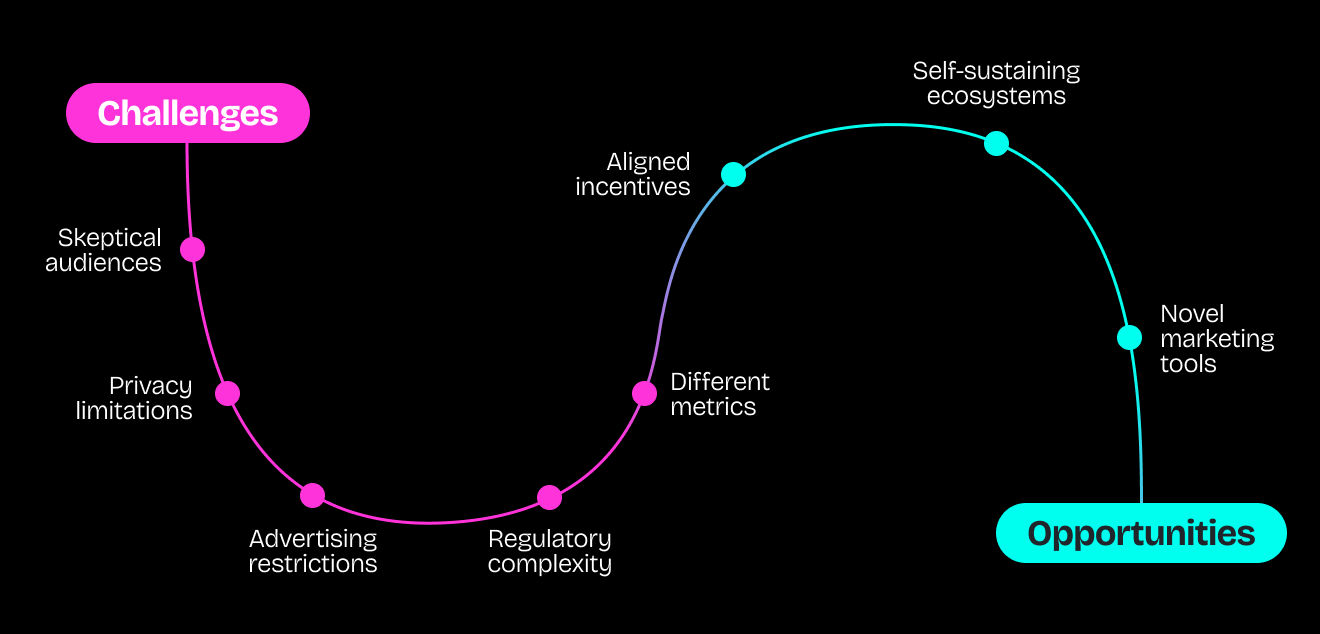
Crypto marketing agencies deal with constraints that would make traditional marketers quit on day one.
The crypto market attracts technically sophisticated users who will tear apart your white paper if your tokenomics don't make sense. They've lived through multiple market cycles, watched countless projects fail, and developed excellent scam detectors. Try to oversell your blockchain project with vague promises about "revolutionary technology" and watch your Discord turn into a graveyard.
Privacy concerns limit your marketing toolkit—many tracking and attribution tools that power Web2 marketing simply don't work when your community values pseudonymity. You can't build detailed user profiles or retargeting campaigns. Traditional conversion rate optimization becomes nearly impossible when on-chain behavior matters more than website clicks.
Google Ads, Meta platforms, and most mainstream ad networks have strict policies around cryptocurrency marketing. Many crypto ads get rejected automatically. Even when you can run campaigns, compliance requirements and platform limitations make it harder than advertising in virtually any other industry. Crypto marketing agencies need to navigate these restrictions while finding alternative channels that actually reach your target audience.
Marketing a DeFi protocol or launching a token requires understanding securities laws, compliance requirements, and regional restrictions. Say the wrong thing in your marketing materials and you might face regulatory scrutiny. Smart contract audits, proper disclosure, and careful messaging aren't optional when you're operating in this space.
Traditional marketing obsesses over conversion rates, click-through rates, and customer acquisition costs—in crypto, those numbers tell you almost nothing about actual success. What matters is on-chain activity, community engagement depth, token holder growth, governance participation, and cultural momentum. A crypto marketing agency worth hiring knows how to measure what actually drives sustainable growth.
The challenges are real, but so are the opportunities that simply don't exist in traditional marketing.
Blockchain technology enables direct, transparent engagement with your users—no intermediary platforms taking a cut or controlling access to your audience. Token-based reward systems create aligned incentives where community members benefit directly from the project's success. This fundamentally changes the relationship between projects and their communities.
Web3 communities can become self-sustaining ecosystems that market themselves. When your users are also your stakeholders, you're not just building an audience—you're building a movement. The best crypto projects have communities that create content, defend the project during FUD storms, onboard new members, and drive organic growth without constant intervention from the core team.
Decentralized social platforms, on-chain reputation systems, NFT-gated communities, bounty campaigns, token-based governance. These aren't just buzzwords—they're actual mechanisms for building engagement that traditional marketers couldn't access even if they wanted to. The goal of crypto marketing isn't to acquire customers. It's to build believers, contributors, and evangelists who see themselves as part of something bigger than a product.
Community isn't just important in crypto marketing—it's everything.
Your community is your distribution channel, customer support team, quality control system, governance mechanism, and most credible marketing voice all rolled into one. Without an engaged community, even the best blockchain technology struggles to gain traction.
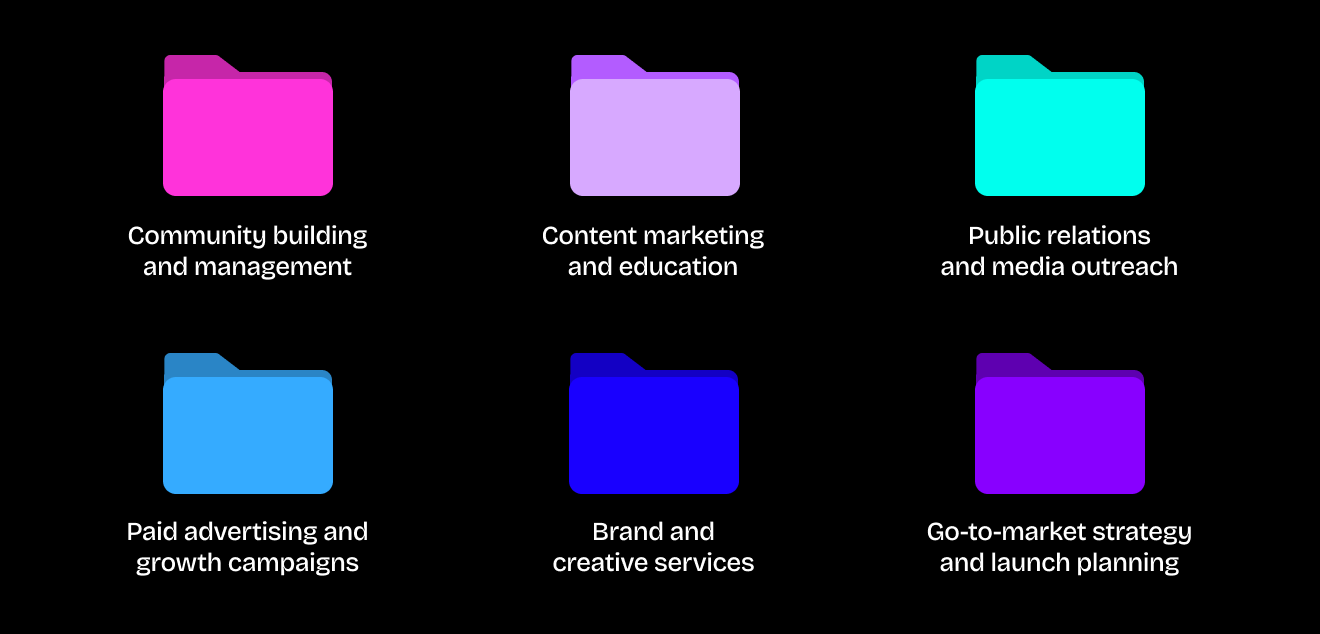
A Web3 marketing agency builds and manages communities across the platforms where Web3 actually happens.
Real community engagement means fostering substantive discussions about your protocol's development, organizing events that bring members together both virtually and in-person, managing governance proposals and facilitating productive debate, creating onboarding experiences that help newcomers feel welcome and understand your project, and building a culture that reflects your project's values.
It means having moderators who actually understand your blockchain technology well enough to answer technical questions about smart contracts, tokenomics, and protocol mechanics.
The best agencies excel at social media management across multiple channels simultaneously, knowing that each platform requires a different approach. What works on Twitter doesn't work on Farcaster. Discord conversations require different energy and depth than Telegram groups. Professional social media management means crafting platform-specific content and engagement strategies rather than copying the same message everywhere.
The difference between community management and actual community building is the difference between having 50,000 Discord members who never talk and 5,000 members who actively participate, create content, and recruit others. Quality always beats quantity in crypto communities.
Most blockchain projects involve genuinely complex technology. DeFi protocols with novel AMM mechanisms. Layer-2 scaling solutions with technical trade-offs between security and speed. NFT platforms with unique utility models and royalty structures. You can't market these with surface-level messaging that sounds impressive but says nothing.
Education-first content marketing is how crypto projects build credibility and attract informed users. A strong content strategy creates blog posts that explain your protocol's mechanics in detail, technical explainers that break down how your smart contracts work, video tutorials that walk users through actual usage, Twitter threads that make complex concepts accessible to newcomers, and white papers that provide the technical depth serious users and investors demand.
This content serves multiple purposes:
Crypto SEO, GEO, and search engine optimization require specialized knowledge. The keywords people search when exploring blockchain technology, researching DeFi protocols, or evaluating NFT projects differ dramatically from traditional software searches. A crypto content marketing agency understands these search patterns and creates content that ranks for terms your target audience actually uses, not generic business jargon.
Good content marketing also means knowing what not to say. Overpromising, making unrealistic claims about returns, or using hype-driven language might generate short-term attention, but it destroys long-term credibility with the exact audience you need to attract. The best crypto content is clear, fact-based, and honest about trade-offs and limitations.
Securing meaningful media coverage requires relationships with the right journalists and understanding which publications matter. Crypto PR is fundamentally different from traditional public relations. What works is genuine news value and authentic stories.
A crypto PR agency:
While organic growth is paramount, strategic paid advertising can accelerate awareness when executed properly. The challenge is that most platforms have strict restrictions on cryptocurrency marketing.
Beyond paid ads, agencies often coordinate complementary channels like email marketing to nurture leads and keep the user base engaged over time. Email marketing in crypto works differently than traditional B2B—it's less about sales funnels and more about education, governance updates, and building long-term relationships with your community and user base.
In a market where most projects offer similar capabilities, your brand identity makes the difference between capturing attention and disappearing into noise. A Web3 design agency that understands crypto culture creates brand systems that resonate, including visual identity, UI/UX design that makes complex protocols intuitive, and NFT marketing.
User experience design matters enormously. Bad UX drives users away regardless of your technology. A crypto design agency makes blockchain interactions feel natural through clear feedback and helpful error messages.
Launching a crypto project is nothing like launching traditional software. A crypto marketing firm provides GTM planning that accounts for Web3's unique dynamics, including developing messaging and positioning, planning token generation events (TGE), coordinating exchange listings, and structuring airdrop campaigns.
Launch planning requires understanding market cycles and community psychology. The agencies that excel have been through multiple cycles and know how to build momentum that sustains beyond launch day.
Not all crypto marketing agencies are created equal. Here's what separates genuine partners from those just riding the Web3 wave.
The bare minimum is genuine understanding of blockchain technology and Web3 culture. Good agencies have team members who understand how decentralized finance works, consensus mechanisms, why certain DeFi protocols succeed, how NFT marketplaces create value, and differences between blockchain networks. Native fluency means understanding the memes, inside jokes, and unwritten rules. Experience navigating market volatility matters—agencies that survived multiple cycles know how to respond to FUD campaigns.
Any agency can claim expertise. Good ones prove it with case studies showing measurable results across different cryptocurrency projects. Concrete results matter more than impressive client lists. Did they grow the community? Drive on-chain activity? Be skeptical of vague "brand awareness" claims.
The best agencies think in terms of building communities, not audiences. Community building is about fostering relationships and active participation. They care about engagement depth, not just follower counts. They track governance participation, not just Discord member numbers. Transparency matters more than promotional polish.
Many agencies excel at creating impressive strategy documents. Then nothing happens. The best prioritize hands-on implementation—they create the content, manage the communities, and execute the campaigns. They demonstrate adaptability during market volatility and bring real resources, not AI-generated mediocrity.

Not every project needs an agency, but certain situations make external support valuable:
Approaching a major milestone: Pre-launch periods demand intensive marketing work. The six months before a token generation event typically require more coordinated marketing than the entire previous year.
Need specialized skills quickly: There's a shortage of skilled marketing talent in crypto. Agencies give you immediate access to pre-vetted resources who know the space, with flexibility to scale up during bull markets and pull back during bear markets.
Want strategic partnership: The best relationships go beyond vendor transactions. You're bringing on strategic allies who understand your long-term vision and operate as an extension of your core team.
Warning signs: Traditional marketing isn't working. Community growth has stalled. Messaging isn't resonating. You're struggling with advertising restrictions and compliance.
About Their Experience: Which cryptocurrency projects have you worked with? What results did you achieve (push for concrete metrics)? Can you share case studies? What's your experience with our specific vertical?
About Their Approach: How do you balance community engagement with growth? What's your content marketing philosophy? How do you handle regulatory compliance? What metrics do you prioritize?
About Their Team: Who will actually work on our account? What's your team's background in blockchain technology? How do you stay current with Web3 trends?
About Working Together: What does your typical process look like? How do you handle market volatility? Retainer or project-based work? How do you measure success?
Crypto marketing agencies exist because Web3 demands fundamentally different approaches than traditional marketing. The best agencies bring deep expertise in blockchain technology, genuine fluency in crypto culture, proven experience building communities, and the execution capability to actually implement strategies.
Choosing the right partner matters enormously. A good Web3 marketing agency accelerates your growth, helps you avoid costly mistakes, brings credibility to your project, and operates as a true extension of your core team.
Look for agencies that prioritize community building over audience acquisition, transparency over promotional polish, and long-term sustainability over short-term hype. Demand proof of their experience and results. Make sure their team actually understands your specific vertical, whether that's DeFi protocols, NFT marketplaces, or blockchain infrastructure.
The right crypto marketing agency isn't just a vendor. They're a strategic ally in building something that lasts beyond the next market cycle.
Ready to build a marketing strategy that actually works for your crypto project? Contact us to discuss your launch.
Build the future of Web3 with people who get you. No suits required. Memes encouraged.
