Related Articles


.png)





A fair token launch in crypto means everyone has transparent, equal access to tokens from day one—no hidden allocations, insider discounts, or mechanisms that secretly favor whales. While perfect fairness is impossible, credible fair launches require honest tokenomics, public vesting schedules, and distribution methods that actually match your claims. Most successful projects use a "fair-ish" approach: small vesting-locked team allocations, transparent investor terms, and mechanisms designed to spread ownership widely.
How you launch your token sets the tone for everything that follows. Get it right, and you build trust from day one. Fumble it—or worse, dress up something unfair as "fair"—and you'll be defending your tokenomics for years.
In plain terms, a fair launch crypto project is one where everyone has transparent, equal access to the token from day one without whitelisted discounts, sweetheart deals, or secret allocations to insiders. No launch is perfectly fair. Even Bitcoin, the original fair launch, can be said to have favored the technical few. Fair has always been relative, not absolute.
The goal is not perfection; it is honesty about your tokenomics.
Most teams don’t hit a perfect ideal. And that’s fine if you’re up front about it and your docs match your claims.
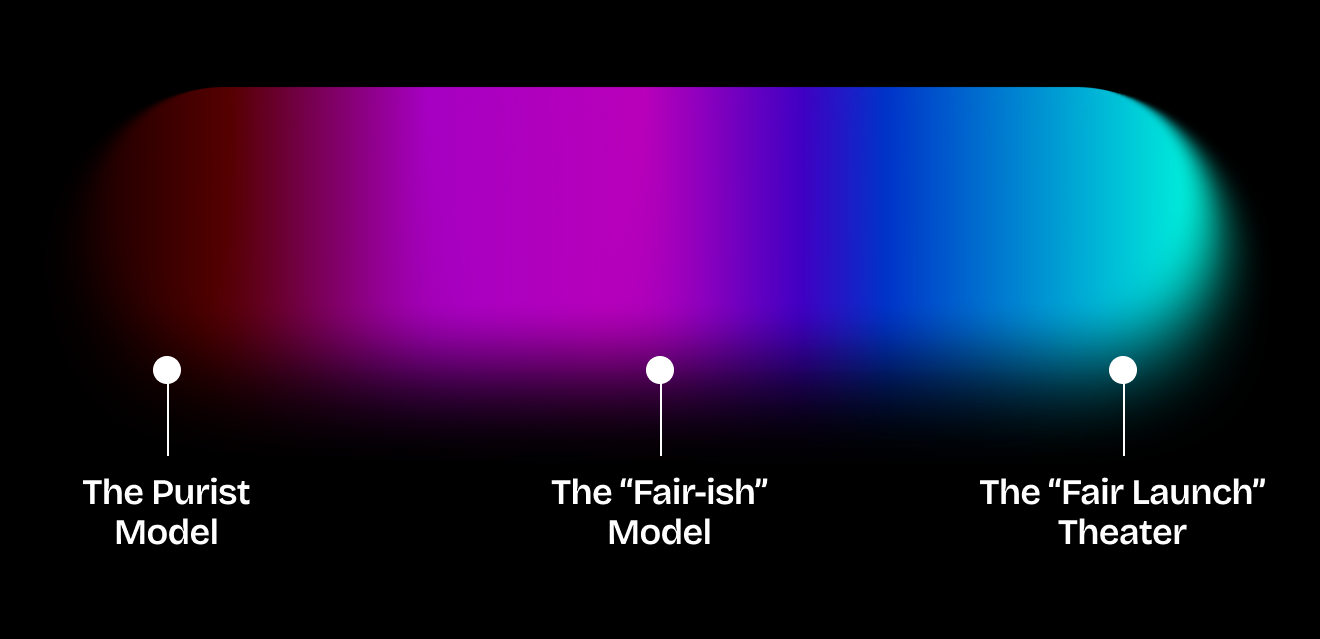
Like most things in life, fair launches exist on a spectrum. Before you plan anything, decide where you sit instead of retrofitting a “fair launch” label later.
The Purist Model: No team allocation. No investor rounds. Tokens are mined, earned, or distributed through mechanisms anyone can access. Think early DeFi experiments where liquidity mining was the only path to ownership.
The "Fair-ish" Model: A small, long‑vesting team allocation. Maybe a modest seed round at (or very close to) the same price everyone else pays. Distribution mechanisms favor participation over capital. This is where most legitimate projects trying to be fair actually land.
The "Fair Launch" Theater: Don't be this. The team announces a "fair launch" while quietly holding significant allocations through shell wallets, pre‑selling a chunk at a steep discount to “strategic” insiders, or using mechanisms that mathematically favor wallets with the most capital. The announcement says fair. The tokenomics say otherwise. Communities figure this out eventually, and when they do, trust evaporates.
Here's where strategy meets execution. The mechanism you choose for a fair launch crypto shapes who ends up holding your token and why they’re there. A well-designed token generation event sets the foundation for how these digital assets flow to your community,
Liquidity Bootstrapping Pools (LBPs): Price starts high and decreases over time, discouraging bots and snipers while rewarding patience. Balancer pioneered this. It's not perfect, but it democratizes access better than simple fixed‑price sales.
Lockdrops and Stakdrops: Users lock or stake existing assets to earn your token. No purchase required—just commitment. This tends to attract DeFi‑native participants who are already active on‑chain rather than pure speculators.
Tiered or Capped Participation: Set maximum contribution limits per wallet. Yes, people create multiple wallets, but caps still help distribute tokens more widely than uncapped free‑for‑alls.
Quest-Based or Participation Airdrops: Reward actual engagement—testnet participation, governance involvement, content creation—rather than just capital. Takes longer to execute but builds a community that's actually in it.
Dutch Auctions: Price decreases over time until all tokens sell and everyone who buys pays the same final price. Fair by design, though requires careful parameter setting.
Map the model to the audience you want: devs, DeFi natives, retail, or a mix. “Fair” to DeFi degenerates is not the same as “fair” to first‑time crypto users.
Fair launch crypto is about more than ethics. It’s a community‑building strategy.
When your community believes the game isn't rigged, they show up differently. They become advocates instead of exit liquidity. They answer questions in Discord, defend you on X, and show up in governance.
The best Web3 communities are built around beliefs rather than tokens. And nothing erodes belief faster than discovering the people shouting "WAGMI" in the group chat got their tokens at a fraction of what everyone else paid.
A credible fair-ish model with thoughtful token distribution aligns incentives from day one. Founders, early users, and later participants all benefit from long-term success. That's how you build believers, not just holders.
You can choose the right mechanism and still fumble the execution. Here's what to avoid:
Vague or buried tokenomics. If your community has to dig through Discord messages and Medium posts to piece together your allocation, you've already lost trust. You need one canonical, always‑updated tokenomics page: supply, allocations, vesting, unlock calendars, and key wallets.
Quiet insider deals that surface later. SAFT agreements, advisor tokens, "strategic partner" allocations—if they exist, disclose them upfront. The blockchain is forever. People will find out.
Distribution mechanisms that favor capital anyway. Uncapped contributions, gas wars, and first-come-first-served during peak congestion—these technically allow everyone to participate while practically favoring whales and bots.
Promising purity you can't deliver. Don't claim a fully fair launch if you have a team allocation. Just be honest about what you're doing and why. “Fair‑ish with transparent tradeoffs” will always hold better than over‑claiming and walking it back later.
Ignoring time zones and accessibility. A launch window that only works for North American hours isn't fair to your global community. Think through who you’re including—and who you’re accidentally locking out—and use longer windows, multiple phases, or staggered waves to give your priority segments a real shot.
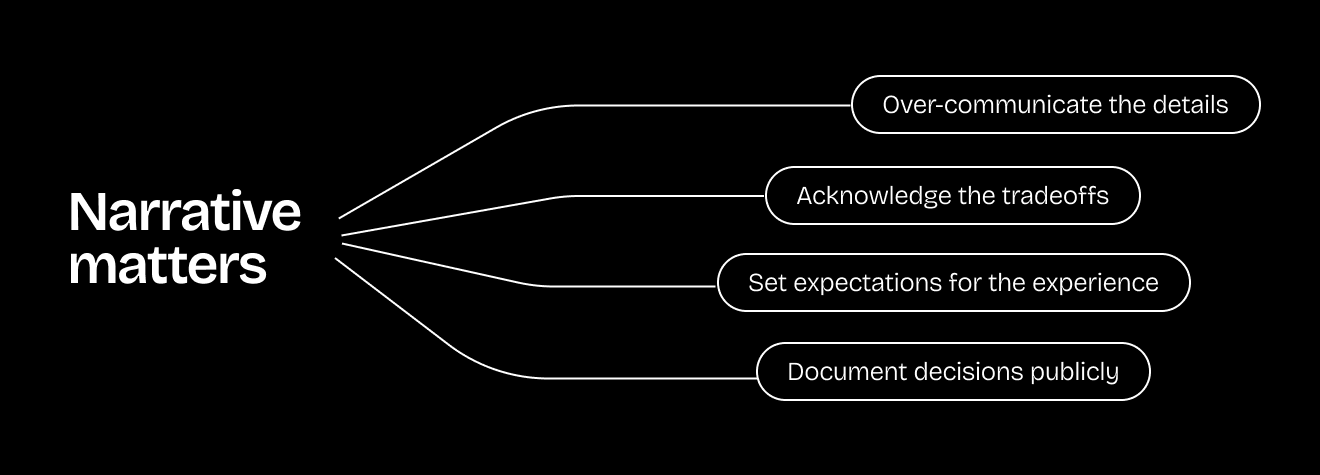
The mechanics matter, but so does the narrative. How you talk about your launch shapes how your community receives it.
Over-communicate the details. Put allocations, vesting, and distribution logic in one hub: a tokenomics page on your site, with summaries in your litepaper, FAQ, and announcement threads. Use diagrams, example timelines, and simple language that non‑technical holders can share with their friends
Acknowledge the tradeoffs. If you have a team allocation, explain why. If you took investor money, explain the terms. Make it clear what you left on the table to stay closer to fair launch crypto principles (e.g., capped investor round, lower insider share). People respect honesty about constraints more than performative idealism.
Document decisions publicly. Publish your distribution mechanism before launch. Explain why you chose it. Invite questions; answer them in public, not in DMs. Publish your distribution mechanism before launch, explain why you chose it, and pin those explanations in your main channels so people aren’t relying on screenshots and rumors.
Set expectations for the experience. Tell people what will actually happen on launch day: timelines, possible failure modes, and what to expect if gas spikes or UI breaks. Plan your “if things go wrong” communication ahead of time—who posts, where, and with what message—so you’re not improvising in crisis
Use this as a gut‑check before you lock in your token launch plan.
If you can’t confidently tick these off, you have a trust problem waiting to happen.
Pure fair launches are rare because they’re hard: no investors, no team allocation, and no safety net if things take longer than expected. They maximize ideological purity but make sustainability tough.
That’s why most credible teams end up in the transparent fair‑ish middle: a small, vesting‑locked team allocation that actually keeps people around; investor rounds sized and priced close to what the community sees; and distribution mechanics picked to spread ownership wide instead of concentrating power in a handful of wallets.
A fair launch in crypto is less about hitting a perfect ideal and more about designing a structure your community can look at and say, “Yeah, that’s fair enough—and I can see why.”
Building a Web3 project and trying to figure out launch strategy? This is when it pays to pressure‑test your mechanics, tokenomics, and messaging with a Web3 marketing agency that lives in these trenches. Let's talk.
Build the future of Web3 with people who get you. No suits required. Memes encouraged.
