Related Articles



.avif)



%20(1).png)
There's a reason you're still building in Web3. Despite the volatility, despite having to constantly explain yourself, and despite watching projects come and go, you see something here worth fighting for.
We do too.
Everyone on our team at Distractive, a blockchain marketing agency, believes in what this technology can actually do. Not just the innovation or the opportunity, but the real problems it can solve. That belief is what keeps us showing up, even when it's hard.
Here's how we all got here, and why we haven't left.

Some of us came to Web3 because we'd seen firsthand what happens when traditional systems fail people.
Ivan, Ecosystem Marketing Manager, grew up in Argentina during the 2001 corralito. Banks froze people's accounts and kept their money. That history shaped how he saw financial systems, and crypto was always present in the background.
He spent years in Web2 marketing for fintech companies. Then he went on a ten-day trek through Patagonia with no phone signal. That disconnection gave him clarity. He was spending all his free time researching DeFi and blockchain anyway. When he got back, he quit his Web2 job and joined Figment, diving into staking, Layer 1s, and institutional adoption. After meeting Nate and connecting with his vision, he joined Distractive.
Joey, Content Manager, I spent years in retail banking watching it quietly break people. A mistake from five years ago meant no checking account. Being poor meant paying fees just to access your own paycheck. Once you were locked out, there was no path back in. I saw it happen over and over, and it broke my heart.
What I witnessed drove me to grad school to study international economics and human rights. That's where I first studied Bitcoin. A currency without gatekeepers felt like everything I'd been looking for, even if I didn't know it yet.
Years later, I fell into crypto through CoinFlip, a Bitcoin ATM company making financial access actually accessible. Working there and later at CoinDesk's Consensus conference, I met builders who showed me crypto's potential goes way beyond financial inclusion. About a year ago, I joined Distractive because everyone on this team has heart and genuinely cares about this work.
Others came because they saw what the technology could enable, not for its own sake, but for what it could change.
Jonathan, Communications and PR Manager, was mining Bitcoin in 2011 when mining pools just handed you 10 BTC to get started. He bought drugs online (allegedly), tried to convince a VOD platform to accept Bitcoin as payment, but eventually lost interest. When the mining pool told him they'd deactivate his account, he had about $250 worth of BTC at $5-6 per coin. He redistributed it to the pool instead of cashing out (and he doesn’t like to talk about it).
Then, in 2018, he read an article about Ethereum and everything changed. There was a whole new tech industry built on Bitcoin's foundation, and people were building real things with decentralized tech. After COVID, he took the first Web3 job he could find at a PR firm. One of his early accounts was Moonbeam, where he met Katie and Nate. When they had an opening at Distractive, he joined the team.
Thomas, Website Manager, came to Web3 because he was frustrated watching the internet get worse. Every platform he used to love had been ruined as companies shifted from serving users to serving shareholders. He believed there had to be a better way. One where users weren't trapped by proprietary systems that could change the rules overnight. Blockchain offered something different: the possibility of building critical internet infrastructure on open protocols that no single entity could control or corrupt.
Jen, Marcomms Director, came to crypto during the dark days of the pandemic when NFTs were exploding. Stuck in lockdown, she started minting her own work and pledging a percentage of proceeds to charity. That experience opened her eyes to blockchain's transformative potential and the idea of embedding a legacy of giving into digital assets. She built that into a startup concept, which became a global finalist in Sound Ventures' "NFT the Pitch" competition. After that, she was all-in.
She redirected her marketing communications expertise toward Web3, consulting for various projects and founders before joining Distractive, drawn by the team's "no smart assholes" commitment and genuine passion for the space.
Katie, Co-founder, has always loved marketing to developers, and she found them in crypto in 2019. Developers are the first to claim they hate marketing, yet they'll proudly slap an Octocat sticker on their laptop while debating their preferred Linux distro. The bar is higher for the quality of marketing they'll respond to, but Katie's always found that brings out the best work. Their brand loyalty, when earned, is incredibly durable.
Nate, Co-founder, jokes that he got into crypto partly from boredom. He was at a conference in his old industry, looked around at a room where the average age was probably 50, and thought "this isn't where the cool kids are." An old boss told him to get into crypto. Three months later, that guy became CEO of Algorand.
The space was full of young coders doing things that had never been seen before, like DEXs and lending protocols. Nate was fascinated. When their previous company broke up, Katie and Nate, who had always worked well together, decided to start Distractive.
Sarah, Director of Digital Marketing, Peter, Social Media Manager, and Anika, Project Manager, all came from different paths, from AI startups to marketing agencies to operations roles across industries. They all saw Web3 as a space where they could grow and contribute to something bigger than themselves.
You know what keeps you here. Maybe it's the technology itself, maybe it's the problems you're solving, maybe it's the community you've found. Whatever it is, it's bigger than the market cycles.
For us, it's all of those things.
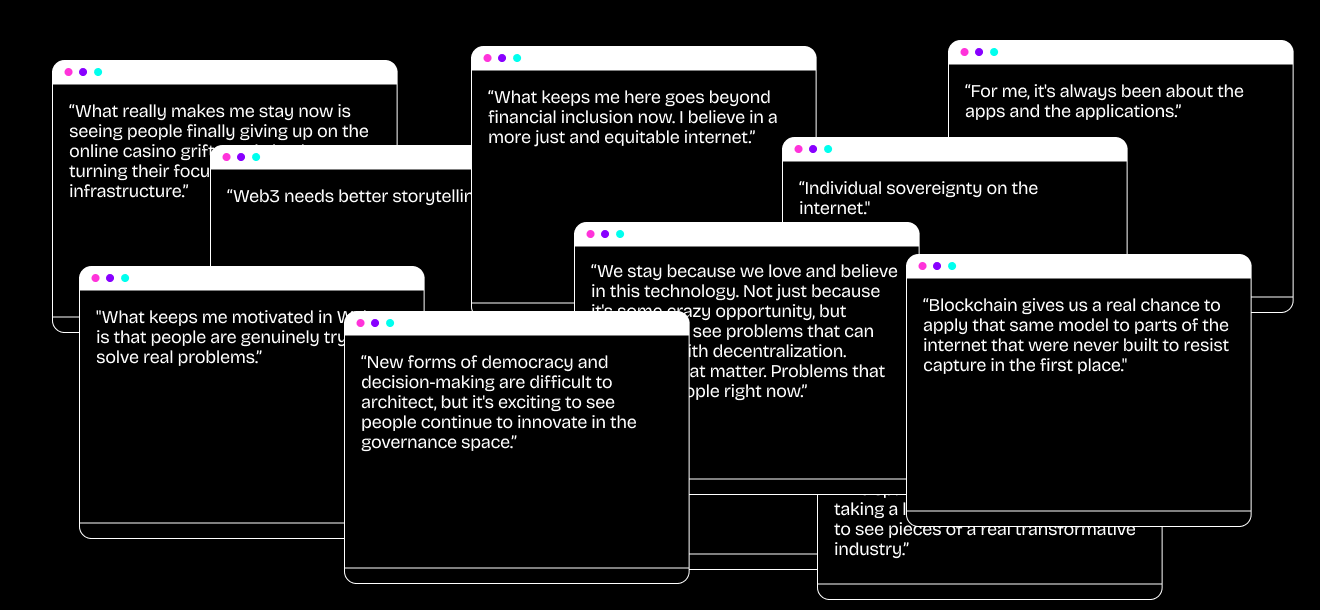
Jonathan stays because Web3 still feels unfinished. "We've certainly taken one hell of a detour away from the initial ethos, but there's still some smoldering coals I'm confident people are blowing on to try and revive. What really makes me stay now is seeing people finally giving up on the online casino grifts and slowly turning their focus back toward real infrastructure. It's messy and frustrating, but it's still pretty much the only industry where technology, culture, and ideology genuinely collide, and where people are still trying to build something meaningfully different from the status quo."
Thomas stays because he believes "systems built on neutral protocols instead of corporate control are the only lasting defense against the slow degradation of the internet. Email is still universally used more than three decades after it was invented because no one owns it, no company can change the rules, and users can leave without losing everything. Blockchain gives us a real chance to apply that same model to parts of the internet that were never built to resist capture in the first place."
Jen stays because she believes Web3 needs better storytelling. "What first drew me to crypto—and what continues to keep me here—is its original ethos. At its best, this technology has a profound ability to empower individuals, shift ownership, and rebalance entrenched power dynamics. Most of my career has been spent either making complex ideas accessible or raising awareness of issues that matter. Web3 needs both—and isn't great at either. As an industry, we often struggle to explain clearly what the tech does, and we're even worse at explaining why it matters for everyday people: the problems it solves, the systems it challenges, and the values behind it. For Web3 to gain real traction, we need better storytelling about why people should care. I remain inspired by the builders and developers I've met who are committed to using blockchain as a tool for change, and that belief continues to drive me."
Katie stays because she's watched the space mature. "For me, Web3 has never been interesting for the technology itself. For me, it's always been about the apps and the applications. As I watch the focus this year transition from narrative-chasing to customer acquisition, product health, and adoption, I couldn't be happier. We're maturing! We've moved away from the extreme gamification of liquidity and into a more sustainable product-building mindset that will create products that strive for something greater than 'XYZ, but decentralized' and actually solve the many problems that Web3 is uniquely able to solve."
Nate sees the transformation happening in real time. "The growth opportunity is still massive here. I think the space is growing up and it's taking a long time, but we're starting to see pieces of a real transformative industry. The tech is starting to change finance, which is super exciting."
Ivan stays because the problems are real and the solutions are working. "What keeps me motivated in Web3 is that people are genuinely trying to solve real problems. In Argentina, international payments are legally complex, slow, and expensive. Web3 tools offer real alternatives that actually work in practice, not just on paper. Every cycle pushes the industry to mature - better infrastructure, better UX, more focus on real-world use cases. You're not just shipping features, you're helping define new financial and technical standards."
Joey, I still think about the people I watched get locked out of banking for reasons that had nothing to do with whether they deserved access to financial services. But what keeps me here goes beyond financial inclusion now. I believe in a more just and equitable internet—one where privacy is protected, where people have true ownership over their data and identities, where access isn't controlled by gatekeepers. Even when the industry makes it really hard to keep believing, I still think crypto can be part of building that world.
Sarah loves the constant challenge. "As a new mom, I think Web3 is a lot like raising kids. The days are long, but the years are short. It's been five years, and it constantly keeps me on my toes. I love that I'm still learning new things every day. I'm excited to see the space maturing."
Peter cares about "individual sovereignty on the internet."
Anika is excited about what governance and AI can do together. "New forms of democracy and decision-making are difficult to architect, but it's exciting to see people continue to innovate in the governance space. I'm especially excited about the potential of AI and blockchain - if done right, this could democratize free information without centralized control. As a former journalist, I think this technology will be essential for whistleblowers and those who value truth over partisanship."
We stay because we love and believe in this technology. Not just because it's some crazy opportunity, but because we see problems that can be solved with decentralization. Problems that matter. Problems that hurt real people right now.
You can't do good blockchain marketing if you don't actually believe in what you're marketing.
We've all seen the agencies that showed up during the bull market, learned some buzzwords, and started taking clients. They pump out content that sounds like every other Web3 project because they don't actually understand what makes this technology matter. They chase trends instead of building strategy. They leave when the market turns.
Our Web3 marketing team is different. We're ride or die. We've got the best of the best, and we're here because we have heart and genuinely love what we do.
Katie understands developer culture because she actually respects how developers think. Ivan understands emerging markets because he lived through financial crisis. Jonathan understands the cypherpunk ethos because he was there in 2011. Thomas understands protocol-level infrastructure and why neutrality matters. Jen understands how to communicate blockchain's transformative potential to creators and communities. Anika understands governance innovation because she cares about democracy. I understand financial inclusion because I watched traditional banking fail people. Sarah understands the evolution of the space because she's been through the cycles. Peter understands what individual sovereignty means in practice.
When we work with projects, we're not just promoting your token. We're trying to help you communicate why your work matters. What problem you're solving. Who you're building for. Why people should care beyond price.
That's the kind of marketing you need when belief matters more than hype. Strategy that holds up through the cycles. Messaging that's rooted in understanding, not buzzwords.
The space is growing up. Slowly, messily, not in the way any of us imagined. But it's happening.
And we're all still here, showing up every day, trying to build something that matters.
If you're looking for a blockchain marketing agency that actually understands your mission because we've wrestled with our own, let's talk.
We believe in something bigger. That's why we stay.
Build the future of Web3 with people who get you. No suits required. Memes encouraged.
